The cost of uncertainty
Why retaining, migrating or funding a complex application becomes more expensive when behaviour, dependencies and evidence remain unclear.

Wayfinder · Harten’s software intelligence platform
Wayfinder helps Harten establish how a complex application behaves, how its parts connect and which questions the available evidence cannot answer.
Harten checks important findings with your team. The work can then become a current-system specification and a proposed plan for change. Your team decides what happens next.
Customer brief
The public Customer Brief explains the buyer problem, the evidence path and the first practical engagement without exposing internal implementation detail.
Why retaining, migrating or funding a complex application becomes more expensive when behaviour, dependencies and evidence remain unclear.
How Wayfinder makes source artefacts, dependency evidence, observations and uncertainty visible enough to discuss and challenge.
How analysis can become a reviewable current-system specification and proposed basis for modernisation planning.
What Wayfinder does
Wayfinder carries application knowledge forward rather than treating discovery, specification and planning as disconnected exercises. Each output is prepared for review; acceptance depends on the evidence and the people accountable for the decision.
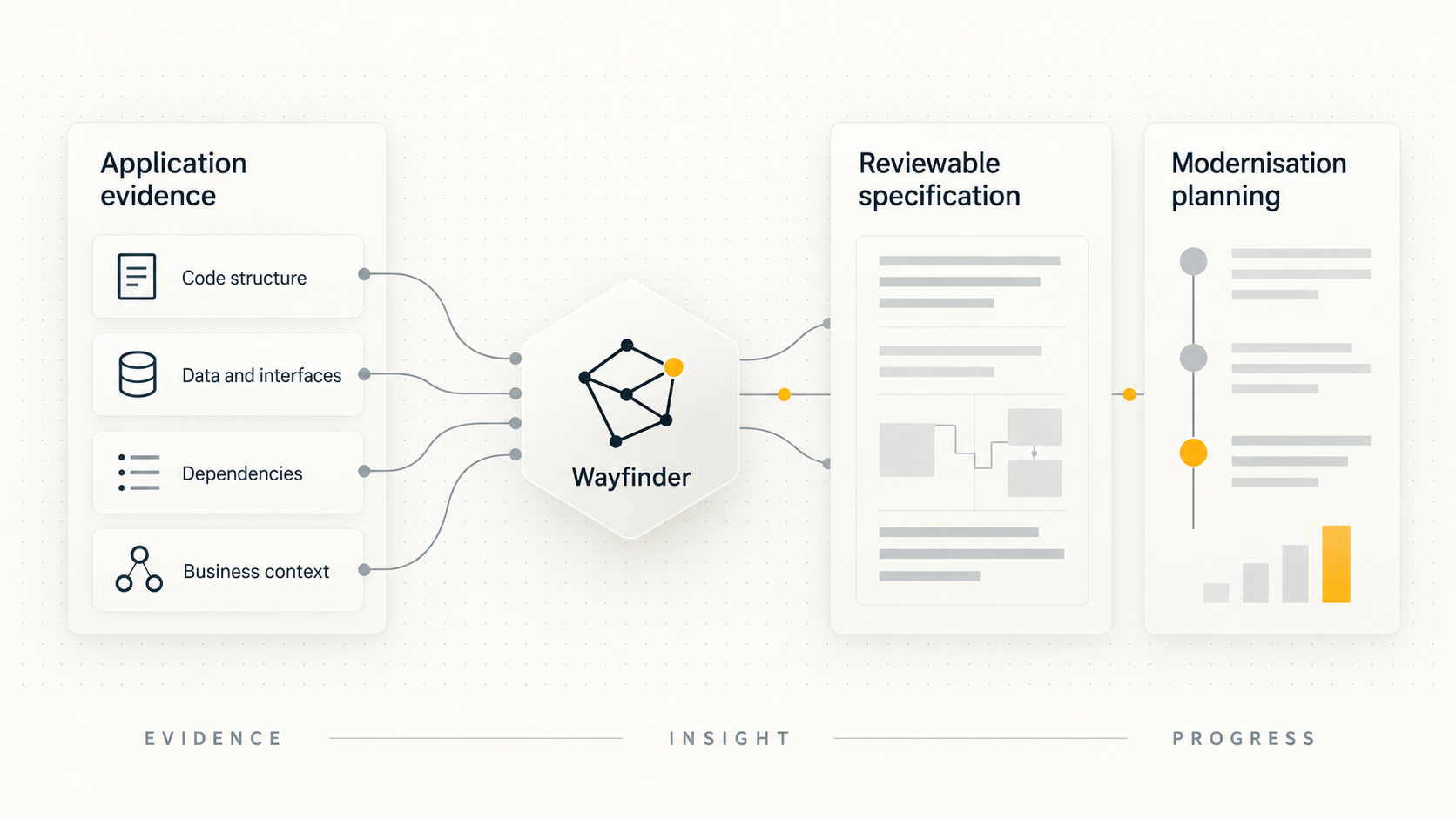
Business capabilities, rules, data relationships, interfaces and exception paths connected to available technical evidence. Questions identify where source alone is insufficient.
Decision supported: where the application boundary and material uncertainties sit.
Functional and technical views bring behaviour, constraints and candidate acceptance checks into a common review. Clarifications and corrections distinguish what is established from what still needs investigation.
Decision supported: which behaviour must be preserved, changed or explicitly retired.
Target architecture, change mapping, migration and rollback, verification, risks, responsibilities and delivery slices. Recommendations are considered against the specification and the customer’s constraints.
Decision supported: whether the proposed sequence of work is sufficiently defined to enter delivery.
Material findings retain the source support needed for review. Missing evidence, unresolved interpretation and generated error are treated differently rather than being collapsed into one confidence score.
Decision supported: what can be relied on, what needs correction and what still requires investigation or human judgement.
The review standard
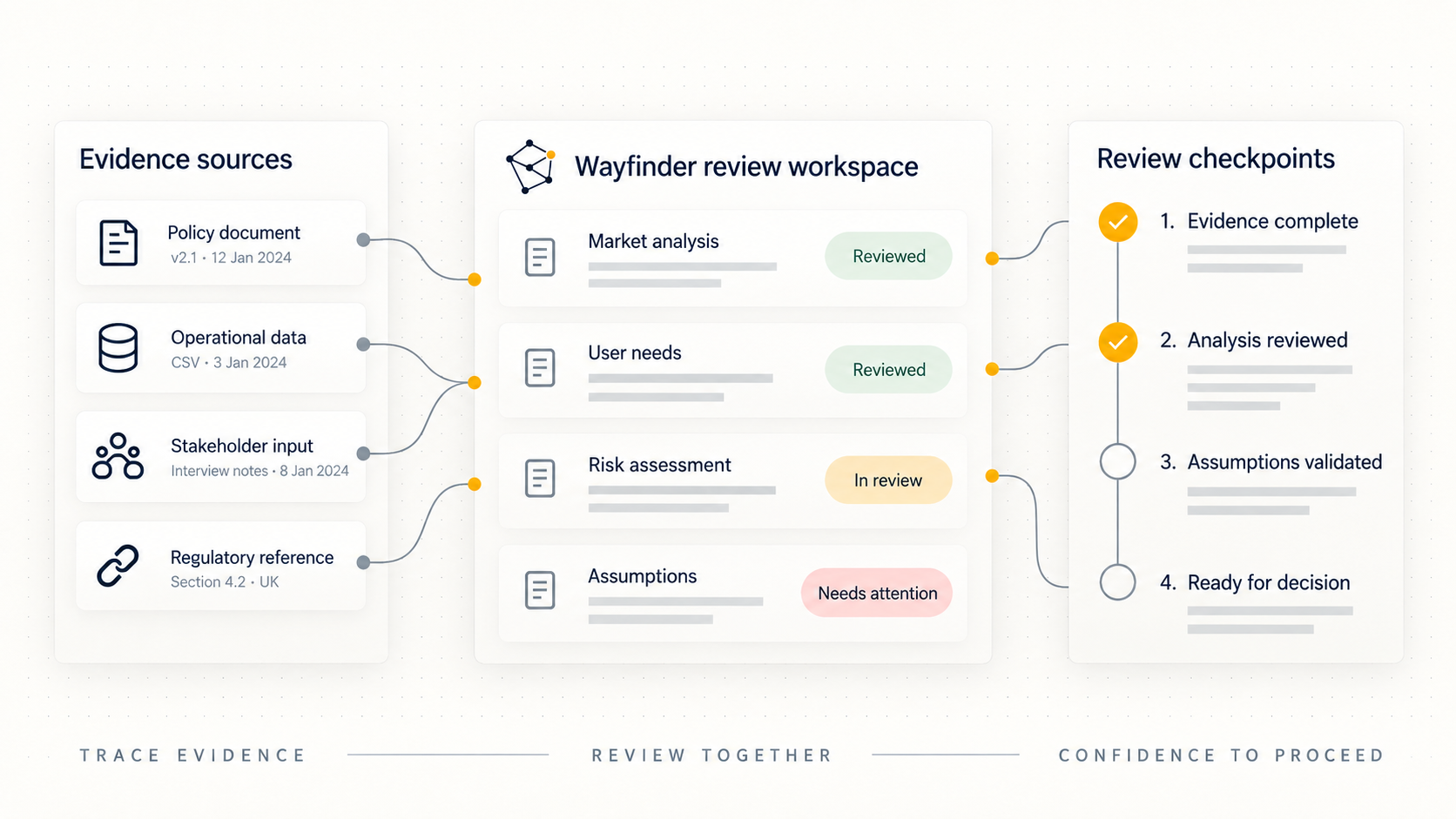
Examine the work
The examples combine selected Harten outputs with source checks and an explanation of their implications. They let you inspect the quality of the reasoning without publishing the underlying platform implementation.
Why a bill-payment rule, a stale-update check and a batch rejection record belong in the replacement specification. Follow those findings into proposed verification and planning.
Examine CardDemoWhy dates cannot be reduced to one generic rule, and why a financial guarantee’s status affects the wider shipment service.
Examine PRSD-IWSHow Wayfinder is used
Wayfinder analyses available application evidence to reconstruct behaviour, dependencies, data relationships and interfaces. It carries that understanding into a current-system specification and proposed modernisation plan.
Used in Harten engagements
Application analysis, current-system specification generation and proposed modernisation-plan generation are used within Harten-led engagements. Scope and review depth are agreed for each application.
In development
Connecting approved specifications and plans to delivery verification, and keeping portfolio status aligned with the latest application records, remain areas of development.
Evidence boundary
Material findings still require evidence and review. Public examples demonstrate understanding and planning work; they do not establish customer acceptance, completed migration or production operation.
Implementation, executed verification and operational transition require separately agreed delivery scope and evidence.