
The Modernisation Control Papers — 07.2
Give agents boundaries they cannot quietly cross
A worked control design for an engineering agent: useful development freedom, independently enforced release authority, protected approval and evidence, and explicit handling of bypass attempts, changed candidates and withdrawn permission.

What This Paper Examines
An agent told to prepare a change without deploying it may still be able to reach production through a build script running with release credentials. The surrounding engineering system must prevent the development task from using that route. Permission to act is not permission to decide examined how an agent keeps authorised work directed towards the intended outcome. This paper follows the same illustrative payment change into the systems that enforce permissions, retain checking results and accept a release. I would protect those controls from the code and identity doing the implementation, while leaving the agent free to investigate, edit, test and repair. The reader should be able to follow an authorised release and explain why a changed candidate or withdrawn approval cannot take the same route. These are proposed checks, not results from a deployed system.
The Engineering Task
The example in AI agents need bounded authority concerns a team building a replacement payments application from agreed requirements. The approved change raises the automatic-processing threshold for otherwise eligible payments from £5,000 to £7,500. An account class still requires manual review, and operational holds still prevent automatic release. These requirements describe outcomes the replacement must preserve; they do not require it to copy the old application's internal design.
The agent may inspect the relevant implementation, refactor the decision path, update configuration, extend tests and prepare a candidate. A £6,000 payment from an ordinary eligible account should no longer be stopped by the amount limit. The same amount from the manual-review class must still be reviewed. An active hold must still prevent automatic release. The specification supplies the equality condition, currency treatment and aggregation rules.
For this task, the agent works with synthetic records and authorised application evidence. It can run development services and use approved tools within the agreed resource budget. It cannot submit live payments, waive acceptance conditions or release the candidate. That leaves substantial engineering work to complete without asking a person to approve each command. The design extends the delegation discussed in Machines directing machines by examining the systems that must enforce its limits.
The Release Route and Its Owners
I would separate the development identity from the identity used to change the production environment. The development identity can write to the candidate workspace and invoke development checks. The release identity belongs to a controlled service that accepts a defined deployment request. It does not offer a general privileged shell. Production access rules permit the release identity to perform the specified deployment operations. The development identity has none of those permissions, and the development environment has no direct network route to the destination. Here, the destination is the deployment control in the target environment that decides whether to accept the requested operation for execution.
On the permitted route, the agent prepares a candidate comprising the proposed software revision, built artefact and relevant configuration. Controlled checking records the required results. The responsible release owner, or an already authorised release policy, establishes permission for that candidate and its intended environment. The release service matches the request to those records, and the destination performs its final authority check before accepting the operation. Existing build platforms, identity services and deployment controls can perform these responsibilities. A team need not build a new service for every role, provided the agent cannot use its development permissions to change the effective controls.
The release service must establish who requested the operation, which authorised task it concerns, what artefact and configuration would run, which environment would receive them and whether the requested operation is within current release authority. It authenticates the caller and resolves the applicable task, scope and approval from protected records. The agent may supply a candidate or task identifier for lookup; it cannot establish its identity or permission by asserting them in the request. The service's own credentials enable execution, but each request must still satisfy the applicable policy.
NIST's guide to attribute-based access control describes authorisation in terms of the subject, resource, requested operation and relevant environmental conditions evaluated against policy. Applied here, permission depends on the particular request and its context. Recognising the development identity is insufficient to authorise a production deployment.
The organisation must also control who can change this arrangement. The development agent cannot edit effective acceptance or release policy, replace the services' trusted configuration, issue their credentials, approve its own release or modify the destination's access rules. Policy and approval records can reside in existing engineering systems, provided their permissions distinguish proposing a change from making it effective. Putting them in another file while leaving the agent able to rewrite that file would achieve little.
OWASP's guidance on excessive agency recommends enforcing authorisation in downstream systems and validating requests against their security policies. That is the relevant property here: the release service and destination enforce the restriction even if the agent concludes that deploying would be a sensible final step.
A Direct Production Request
Suppose an edge case is difficult to reproduce. The agent proposes changing production configuration to observe how the live service responds. The development task grants no such permission. The development environment should block the direct connection, and the destination should independently reject the development identity if a route becomes reachable. A request sent through the release service should be refused because it lacks applicable authority. Changing the wording from “production change” to “diagnostic adjustment” must not alter the outcome.
The refusal does not establish that production access is necessary. In this example, the agent can construct a synthetic fixture with the account-class exception and operational hold, using the approved rules and authorised configuration information. It can then exercise the relevant decision path locally. If some production-specific fact remains unavailable, the agent should identify that gap and its consequence. A separately authorised operator might supply a sanitised observation without granting the agent production access.
The agent can continue the threshold implementation and other unaffected checks. It should not declare the unreproduced case verified, but neither should it discard completed work. Only a remaining need that cannot be met within existing authority should become a request for a different decision. A denied route is not, by itself, a reason to broaden permissions.
A Workflow That Attempts to Borrow Privilege
Withholding a production password is inadequate if an editable workflow can obtain one. Suppose the agent changes a build script so that, after running tests, it invokes a deployment command. If that script runs on a worker holding release credentials, the agent has gained an indirect route to production through code it was allowed to edit.
In the proposed arrangement, candidate-controlled build and test code runs in isolated workers without production credentials or production access. Editing the script does not change the worker's identity. The attempted deployment should therefore be rejected by the same access restrictions, even though it originated in a build. The controlled release service retrieves the identified artefact through its own deployment procedure; it does not execute arbitrary build, test or deployment scripts from the candidate with its privileged identity. Candidate hooks and plug-ins need the same treatment if they can execute code during release.
The agent might instead propose changing the workflow's identity, assigning it to a privileged worker or removing a required check. Those settings are protected separately. The agent can submit a proposed change for examination, but its development authority cannot make that proposal effective. A merge, branch name or message from another agent must not silently substitute for the approval the release service requires.
This does not mean every workflow edit needs a new human decision. A development workflow can remain editable within its permitted environment. The restriction applies where an edit could acquire additional privilege or redefine acceptance. The same distinction matters for dependencies and file access: an apparently routine operation can require a control when it introduces executable code or exposes information beyond the authorised task.
Approval of an Identifiable Candidate
Once the work is ready, the responsible people may authorise its release. The release record should identify the candidate revision, built artefact, relevant configuration, destination, permitted operation and limits on its scope. A controlled build service records the resulting artefact's content digest, a cryptographic fingerprint used to match the actual built content, and associates it with the revision and build inputs. The release service obtains that record independently and verifies the retrieved content and configuration before use. Neither a mutable filename such as “latest” nor a digest supplied solely by the agent establishes what the reviewer examined.
Suppose an approval covers candidate A, but the agent subsequently changes its implementation and builds candidate B. A request to deploy B using A's approval should be refused. The earlier decision may be applicable under a separately defined policy for permitted changes, but the agent cannot establish that merely by describing its edit as harmless. Without such a policy, the changed candidate requires the appropriate release review.
This is distinct from reopening the payment policy. The decision to raise the threshold while preserving the exception can remain valid across many implementation revisions. Reworking a function does not require the policy owner to approve the same business outcome again. It does require the resulting candidate to satisfy that outcome and any release conditions that apply to it.
OWASP's transaction-authorisation guidance recommends protecting approved details, checking authorisation at execution and preventing inappropriate reuse. Applying those principles to software release is an engineering inference. The proposed release service checks the operation and content being executed, rather than relying on an approval message detached from them. An organisation may also authorise automated release for a defined class of changes; that authority must be explicit and checked by the service.
Behavioural Checks and Protected Evidence
Access controls can refuse a deployment. They cannot, by themselves, determine whether a refactor preserves manual review. For this payment change, the candidate must also be examined against the approved outcomes. Relevant checks should exercise ordinary eligible accounts, the exception class and operational holds, with expected results grounded in the requirement rather than generated solely from the implementation being tested.
The agent may correct a test expectation that demonstrably reflects the superseded £5,000 limit. It may add cases and repair its own defects. It cannot make an unresolved failure acceptable for release by deleting the case, changing the controlling requirement or marking the result as waived. Proposed changes to the acceptance basis need the authority appropriate to their meaning. Development tests can remain editable within the task. Where a test forms part of the protected release checks, its effective change follows the authorised acceptance-change route. Applying the already approved £7,500 requirement through that route need not reopen the business decision. Removing the manual-review condition would change the required outcome and needs different authority.
The record also needs a source independent of the agent's account of success. For the manual-review case, the checking system must observe how the candidate handles the payment and compare that behaviour with the approved expected outcome. A message from the candidate's own test script saying that the case passed is insufficient. I would use a protected checking controller to select the required checks from controlled acceptance configuration, start them and retain the results. The checking harness is the software that supplies the inputs, observes the candidate's behaviour and compares it with the expected outcomes. Both that harness and the route used to record its results must be protected from changes by candidate code.
Where a check executes candidate code, that code remains in an isolated worker without the controller's credentials or write access to the evidence store. The controller records the checked artefact's digest and configuration identity, the applicable requirement and check versions, and the observed outputs and failures. The agent can attach attributable explanations and investigation links, but cannot overwrite the captured results.
Protecting a check does not establish that its expected result is correct or that it covers every relevant case. Engineers still need to assess the requirement, harness and observations, particularly when the meaning of a failure is disputed. A corrected acceptance condition must go through its authorised change route and return to both implementation and checking. Otherwise, the controller could reliably preserve evidence for the wrong expectation.
Similarly, a refused release should produce a record from the enforcing service identifying the authenticated caller, requested candidate and operation, target, policy version and decision. The agent's explanation of why it tried the action is useful context, but is not the source of those observed facts. These records make examined attempts traceable; they do not establish that every semantic defect or unexamined route has been detected.
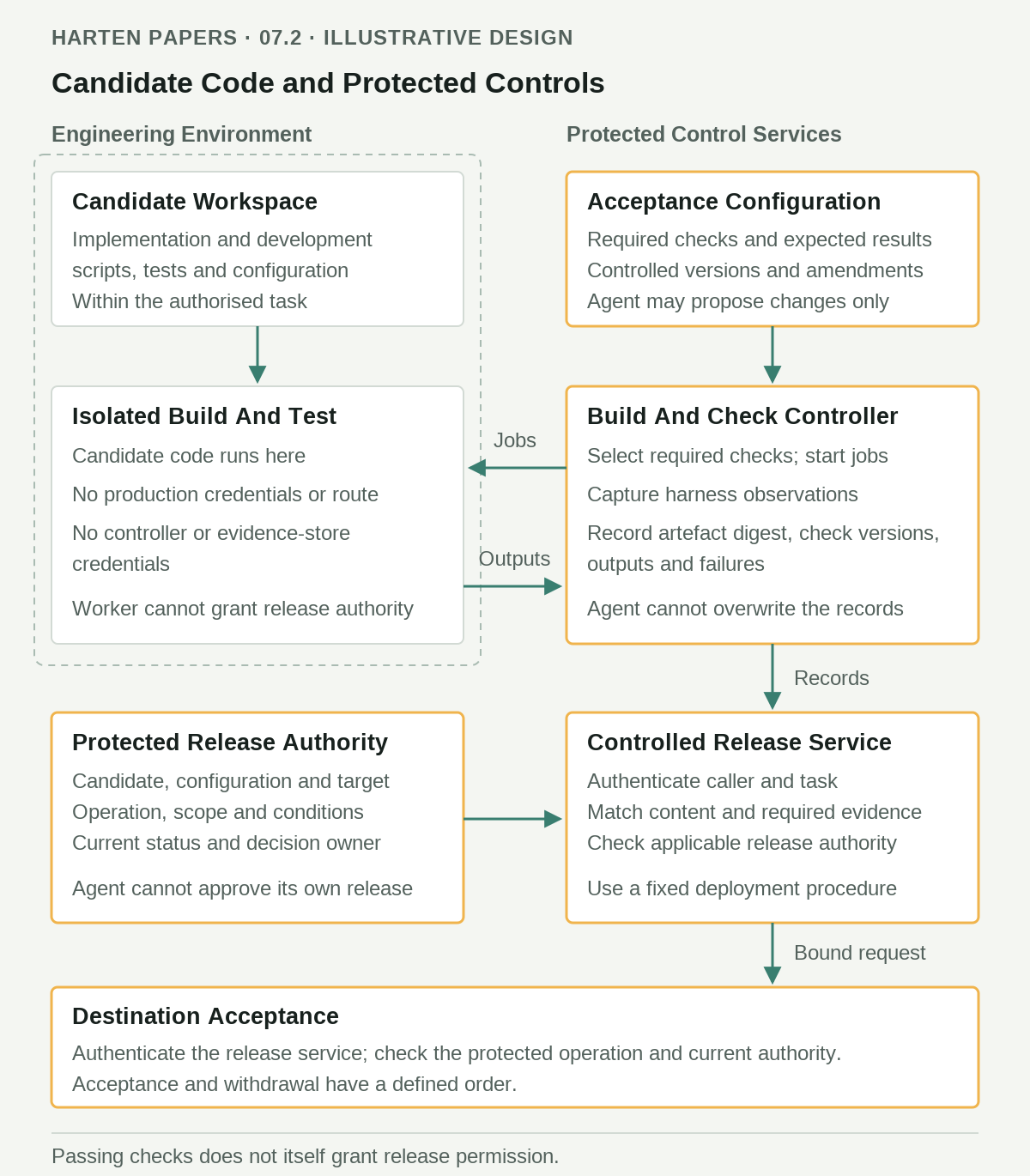
Candidate code may change freely within the engineering task. The services that select required checks, retain evidence and authorise production actions remain outside that code's control. Arrows show the permitted control and evidence paths in this illustrative arrangement. View the diagram at full size.

Withdrawal, Interruption and Continued Work
Release permission can expire or be withdrawn after approval. A queued request must not retain permission merely because it was created earlier. I would make destination acceptance the final decision point in this arrangement: the destination authenticates the release service and verifies the protected request against current authority for that candidate, configuration, target, operation and scope. If current authority cannot be established, the request remains blocked while development work that still has valid authority can continue.
Ending the conversation does not stop a queued job or remove credentials already held by a worker. Each release job therefore needs an identifiable request whose recorded state can be inspected after interruption. Here, acceptance means the destination's final commitment to execute the identified operation. Receiving the request or placing it on a queue does not count. The deployment route must provide that controlled acceptance point; an ordinary receipt acknowledgement does not establish it.
Suppose the release owner withdraws permission while an approved request is waiting. If withdrawal takes effect before acceptance, the destination must block the request. If the destination has already accepted it, the operation remains identifiable and may already be taking effect. The enforcing system must establish the order of withdrawal and final acceptance. A request must not pass the authority check, lose its permission before acceptance, and then proceed on the earlier result. The accepted request must also be protected against substitution or unauthorised reuse.
An operation already accepted by the destination may have taken effect even if its acknowledgement was lost. Revoking permission does not undo that effect. Before retrying after interruption, the release service must check the recorded state of the original operation and follow the defined recovery procedure if its outcome remains uncertain. Planning recovery before a new application changes live data examines that problem more fully. Here, the relevant limit is that an interrupted agent cannot treat a missing response as authority to repeat a consequential action.
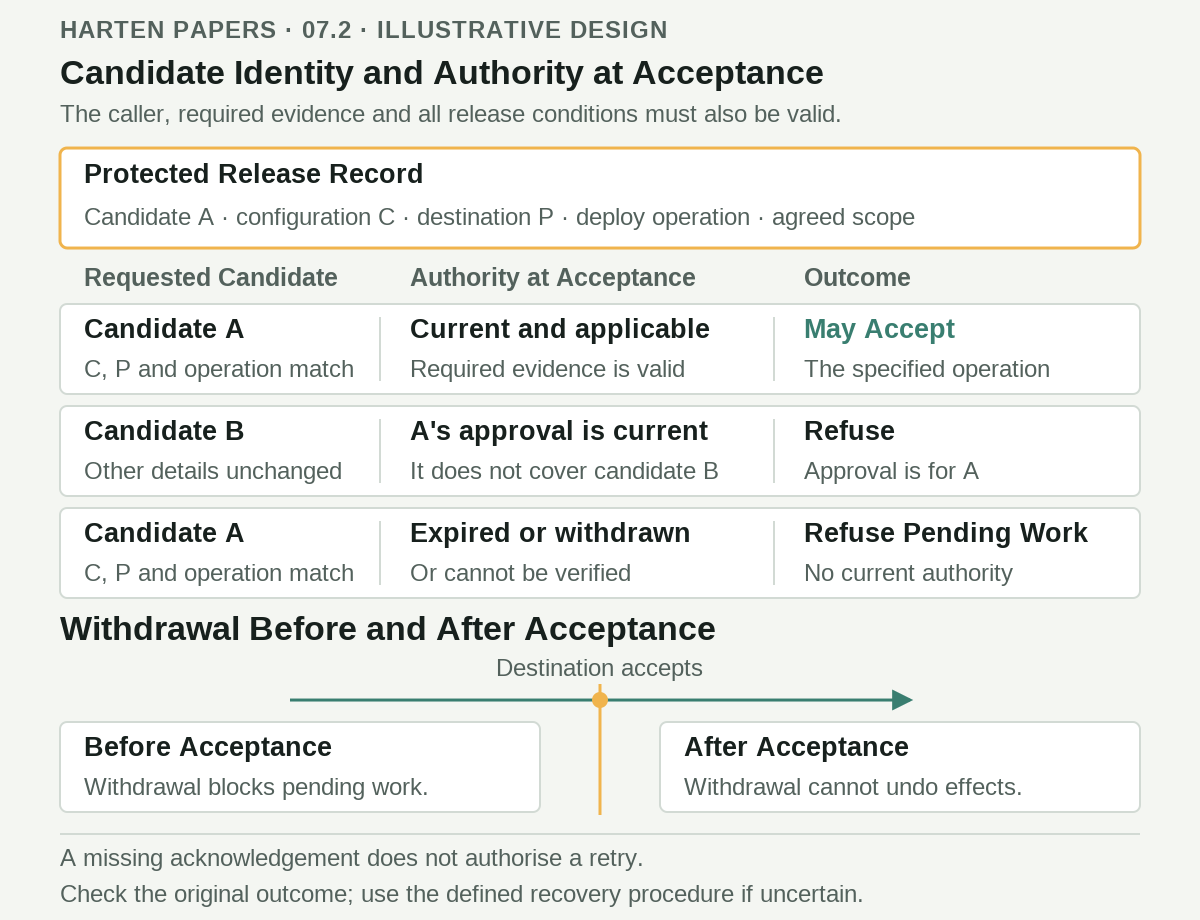
Candidate identity and current authority are checked for the operation being accepted. Withdrawal blocks pending work at that point; it cannot retract an operation the destination has already accepted. These cases illustrate the proposed control and its limit. View the diagram at full size.

These checks should preserve useful work. If authority and candidate identity remain unchanged, the agent should resume the authorised task from its recorded state. Expiry of a release permission need not invalidate the policy decision, erase the candidate or force a repeat of completed investigation.
Expected Results From the Proposed Checks
I would exercise the arrangement in a controlled environment before relying on it. The following are expected results to establish, not observations from a Harten deployment.
| Proposed Check | Expected Result |
|---|---|
| Complete the threshold implementation within the development task | The agent prepares the candidate and evidence without approval for every edit. |
| Request a production change without release authority | The enforcing network, destination or release service refuses it and records the reason. |
| Add deployment to a candidate-controlled build script | The worker gains no production privilege; the attempted action is denied. |
| Change the required checks, alter their protected harness or overwrite captured results | The development identity cannot make the protected change effective; a permitted proposal remains available for review. |
| Request a changed candidate using an earlier candidate's approval | The release service refuses unless a defined policy establishes applicable authority. |
| Execute after release permission expires or is withdrawn | Pending work cannot pass the final acceptance check; already accepted work remains identifiable. |
| Lose the acknowledgement after the destination accepts a release | The original request is traced before retry; missing acknowledgement grants no new permission. |
| Release the unchanged approved candidate under current authority | The service can complete the authorised operation without another discretionary signature. |
A candidate that lets the exception class bypass review should also fail its relevant acceptance check, for a different reason: it does not implement the approved behaviour. Testing the deployment gate alone would not establish that this behavioural check works.
Conclusions
An engineer reviewing an agent workflow should first establish whether candidate code can alter the controls used to judge and release it. In this example, the agent may implement and repair the threshold change, but it cannot make altered acceptance conditions effective, replace the protected checking harness or overwrite captured results. The same review must follow scripts and delegated jobs: denying a production permission to the development identity leaves a gap if code it controls can run under a privileged release identity.
Release approval then needs to be checked against the artefact, configuration, destination and operation actually proposed. A passing check supplies evidence about the candidate; it does not grant release permission. An approval for an earlier candidate cannot silently cover a changed one. That distinction also avoids reopening a settled business decision whenever an engineer repairs the implementation: approval of the £7,500 requirement can remain valid while the revised candidate is checked and its release authority established.
The final judgement is whether that authority still applies when the destination commits to the operation. If permission has expired or withdrawal has taken effect before acceptance, the destination must refuse the request. Withdrawal cannot undo an operation already accepted, and a missing acknowledgement requires checking the original operation before retrying. Where the required checks pass and release authority still applies, the service should complete the authorised operation without another discretionary signature. The agent should also be able to continue development work whose authority remains valid. When a policy or scope decision remains unresolved, the next paper, 07.3, Escalation should help someone make a decision, examines the evidence and choices that should reach its owner.
Editorial note, 26 November 2026: The conclusion has been expanded to make the practical judgements from the worked example explicit. The proposed controls and their stated limits are unchanged.
The payment service, amounts, control arrangement and check scenarios are illustrative. This paper does not report a customer deployment or measured production results. External sources support the practices attributed to them; their application to this example is the author's recommendation.
This paper is part of The Modernisation Control Papers, the first major sequence within The Harten Papers. Read the complete series on harten.io.